Tell us about the job
Takes about a minute. No obligation.
A boiler installation in this area has to be sized and commissioned precisely, because the burner and heat exchanger start cycling in September and keep cycling until June. Homes in Snohomish County, WA run heat about ten months a year, from September through June. An undersized boiler works harder across every one of those months to hold the house at temperature, which pushes the ignition system and heat exchanger toward early failure. A contractor pricing the job has to run a proper load calculation first, not estimate from the square footage, because a system that is even modestly undersized has nowhere to hide when the season is this long.
Ductwork laid out for an older system follows a different logic than what a new boiler installation asks of it. Half the homes in Snohomish County, Washington were built in 1990 or earlier (2020-2024 ACS 5-year). A contractor sizing and placing a new unit has to work out whether the existing runs will carry the new load, and where they will not, what it costs to correct them before the equipment goes in. Electrical service gets the same look. Houses built to that point were wired for what was common then, and what a modern boiler draws may land outside that range.
What a Boiler Installation Puts in Your Home
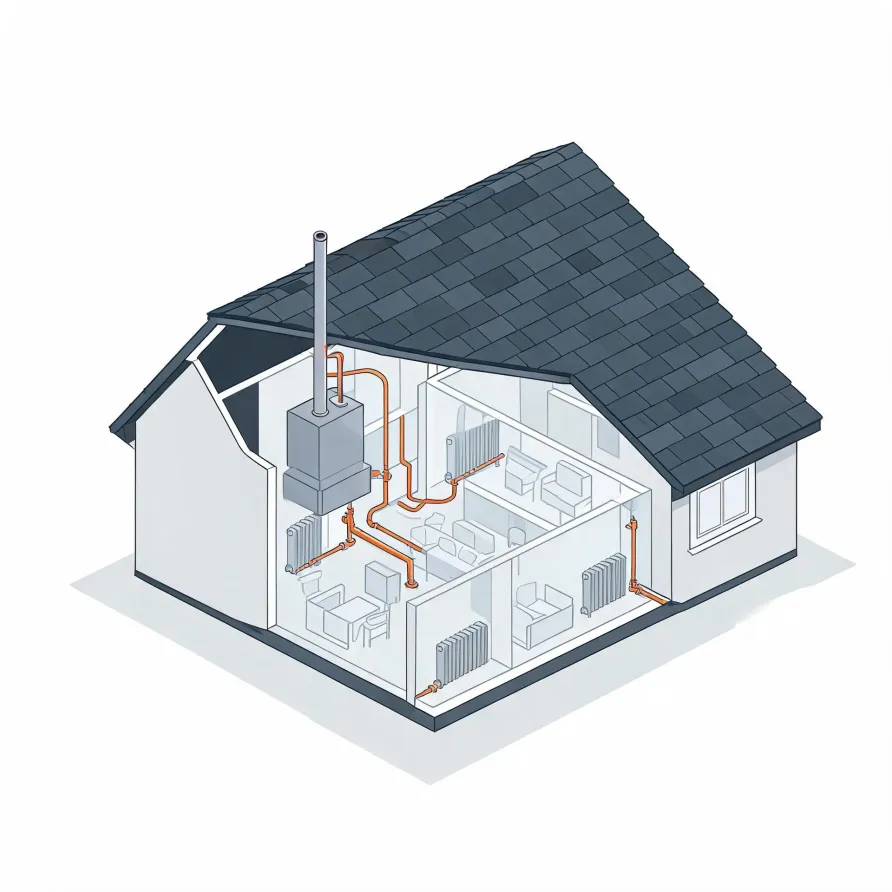
The boiler itself sits in a mechanical room, basement, or utility closet and is the unit that heats water for the whole system. Wall-mounted or floor-standing, it is the piece a contractor anchors first. Attached to it are the supply and return pipes that carry hot water out to the home and back again.
Radiators or radiant floor loops sit at the delivery end, in the rooms themselves, and are where the heat actually reaches the living space. A circulator pump, mounted close to the boiler, moves water through those loops. An expansion tank and pressure relief valve sit nearby to keep the system operating within safe pressure limits.
The drawing shows a typical boiler layout, and a licensed contractor will assess which components apply and how they are configured in your specific home.
Find a contractor in Snohomish CountySnohomish County, by the numbers
Half the homes in Snohomish County, Washington were built in 1990 or earlier (2020-2024 ACS 5-year).
U.S. Census Bureau, 2020-2024 American Community Survey 5-Year EstimatesSnohomish County, Washington holds 331,530 housing units (2020-2024 ACS 5-year).
U.S. Census Bureau, 2020-2024 American Community Survey 5-Year EstimatesOwners occupy 68.2% of the occupied homes in Snohomish County, Washington (2020-2024 ACS 5-year).
U.S. Census Bureau, 2020-2024 American Community Survey 5-Year EstimatesBoiler Installation Rules & Codes for Snohomish County, Washington1 sourced standards and regulations
Licensing and Legal Requirements in Snohomish County, Washington
Washington requires contractor registration rather than an HVAC licence: every contractor must register with the Department of Labor and Industries, and advertising, bidding or working as a contractor without that registration is a gross misdemeanour.